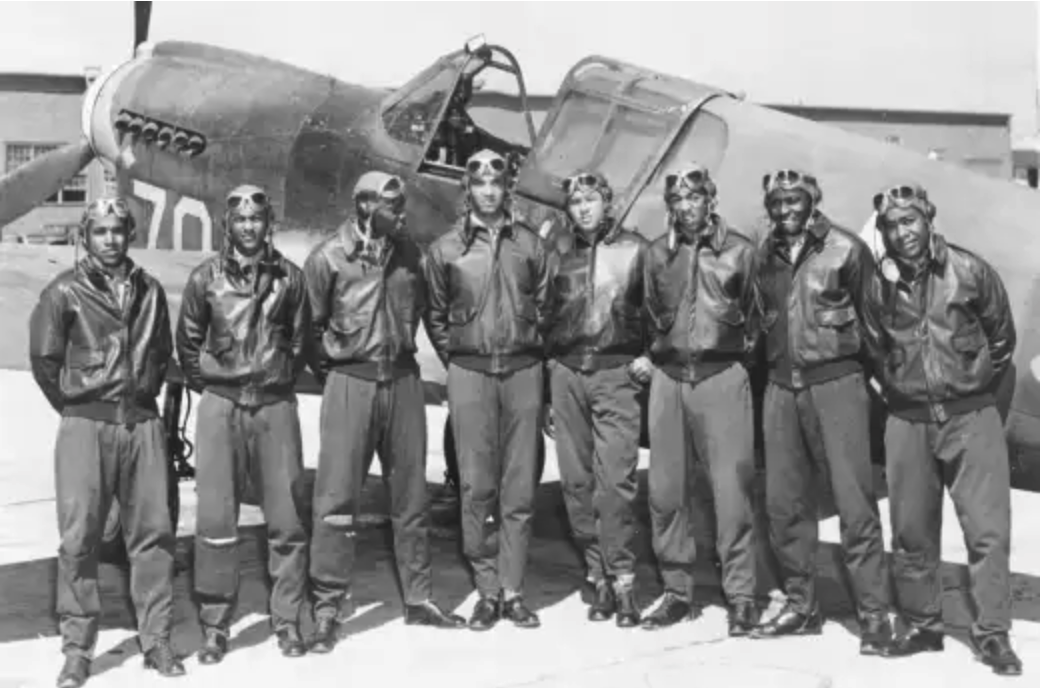

Robert filmed and interviewed the descendants of three African American WWII heroes. All three WWII heroes died on the same calendar day.

Source: Signaleer from Wikimedia Commons (Public Domain); Canva

Colonel of the Tuskegee Airmen
Lt. Col. Luke J. Weathers, Jr. was an American fighter pilot during World War II (WWII). He was one of the legendary Tuskegee Airmen and made tremendous and heroic contributions to U.S. history. Weathers and his fellow Tuskegee Airmen hold the record for the most outstanding pilots and crew efforts in U.S. military history.
Three Heroes Linked
Circumstances have linked Weathers with two other unsung African American heroes from Memphis.
Lt. Col. Luke J. Weathers Jr., PFC Sylvester Rodgers, Sr., and Ernest C. Withers:
- All died on the same calendar day, October 15.
- All served in World War II.
- All made significant contributions to the history of the United States.
The year of death differs for each hero:
- Rodgers died in 1993.
- Withers died in 2007.
- Weathers passed away in 2011.

Weathers and his fellow Tuskegee Airmen hold the record for the most outstanding pilots and crew efforts in U.S. military history.
From Grenada to Memphis
Here are some basic biographical facts about Luke J. Weathers, Jr.:
- He was born on December 16, 1920, in Grenada, Mississippi.
- He moved to Memphis with his family when he was around two years of age.
- He attended St. Augusta Elementary School in Memphis, Tennessee.
- He graduated from Booker T. Washington High School in Memphis, Tennessee.
- His father, Luke J. Weathers, Sr., owned and operated the first African American grocery store in Memphis.

Source: Boston Globe Archives
An Aspiration to Contribute
In 1939, when WWII began, 18-year-old Luke J. Weathers, Jr. had an intense desire to serve his country in the United States military. Many African Americans during that time performed their military duties by cooking or cleaning latrines. Weathers was passionate about contributing to his country in a different capacity.
Luke J. Weathers, Sr. (the father of Luke J. Weathers, Jr.) owned and operated the first African American grocery store in Memphis, Tennessee.
Political Pressures of War
In 1941, the Tuskegee Project, intended to prove the ill-conceived notion that black men (negroes) could not endure flight training, began in Tuskegee, Alabama, at Moton Field. As the war progressed, many reasoned that the United States needed additional pilots, but they could not be black pilots.
They asserted that African American men did not possess the mental or motor skills necessary to operate sophisticated machinery, such as airplanes. However, the Tuskegee project showed that it was false to assume that blacks could not fly a plane.

Accepted in the Program
Because of being involved in The Tuskegee Project, Luke J. Weathers, Jr.:
- Became a member of The Tuskegee Airmen
- Flew with the 332nd Fighter Group and the 302nd Fighter Squadron
- Departed for Italy on January 3, 1944
- Started flying missions in North Africa, Italy, France, and Germany
They Had to Pass the Test
Two movies entitled The Tuskegee Airmen and Red Tails show young cadets having to take and pass the pilot’s test twice. In his autobiography, Luke Weathers, Jr., shows that the young Tuskegee Airmen had to take and pass the pilot’s test four times. Their white counterparts had to take and pass the test only twice.

Source: Awesome Stories
Safely Escorted Bombers
The United States would have had a difficult time winning World War II if it had not been for the exemplary and heroic deeds of the Tuskegee Airmen. The airmen safely escorted countless bombers to their assigned missions.
Historical documents show that The Tuskegee Airmen:
- Hold the best record of air support and air battles in U.S. military history.
- Lost almost no bombers under their protection.
Historical documents show that The Tuskegee Airmen hold the best record of air support and air battles in US military history. They lost almost no bombers under their protection.
Did you know that there were African American fighter pilots in World War II?
- Yes
- No
- I did not think Blacks could fly airplanes.
Head-On Combat
After a previous bombing mission over Germany, Luke Weathers escorted a wounded bomber to England. He flew beneath the bomber to disguise his presence from potential enemy attacks.
Eight hostile planes attacked the bomber. Weathers and two other escorts engaged in enemy contact. Weathers flew into the opposing fleet head-on, immediately taking down one plane.

Source: Aviation Art Hangar
The other seven adversaries came after Weathers, but he did not panic. He put his plane in a dive and quickly throttled up to altitude. As he looked back, he spied an enemy aircraft on his tail.
Through skill and cunning, Weathers ended up on the tail of the enemy plane. With a long burst of machine-gun fire and a few short shots, Weathers caused the enemy aircraft to tumble to the ground.
During one assignment, Weathers flew into eight enemy aircraft head-on, immediately taking down one plane.

Weathers reversed a hostile situation when he sent an enemy aircraft that had been on his tail, tumbling to the ground. Source: Pinterest

On one of his missions, the enemy shot down Weathers over Greece.
Shot Down Over Greece
While flying over Greece on one of his missions, the enemy shot down Weathers. However, with the help of local villagers, he safely made it back to his unit.
An Indelible Mark on History
Placing an indelible mark on history, after returning to his hometown of Memphis, Tennessee, Lt. Col. Weathers received honors never previously given to an African American in that city. History will undoubtedly show and revere Weathers and his fellow Tuskegee comrades as exemplary pilots associated with exceptional crew efforts.
Highways Named After the Tuskegee Airmen
- Interstate 15, between the Miramar Road and Mercy Road interchanges in San Diego, California, is named “Tuskegee Airmen Highway.” Seven former Tuskegee Airmen were present at the unveiling ceremony on February 22, 2013, at Miramar Marine Corps Air Station.
- In 2006, Interstate 70 between York Street and Peoria Street in Denver, Colorado, was named the “Tuskegee Airmen Memorial Highway.”
- In October 2016, Interstate 65 between Seymour and the Bartholomew/Johnson County line was christened “Tuskegee Airmen Highway.”
- The entire 191-mile stretch of the Interstate 75 that crosses Kentucky was named “Tuskegee Airmen Memorial Trail” in July 2010.
This content is accurate and true to the best of the author’s knowledge and is not meant to substitute for formal and individualized advice from a qualified professional.
© 2015 Robert Odell Jr
Leave a Reply